Use this equivalent fraction calculator to generate equal fractions, check matching values, and verify fraction pairs quickly for homework, practice, or everyday math.
This equivalent fraction calculator lets you generate matching fractions in seconds. Enter a fraction, view equal values, and check whether two fractions represent the same part of a whole.
How to Use the Equivalent Fraction Calculator
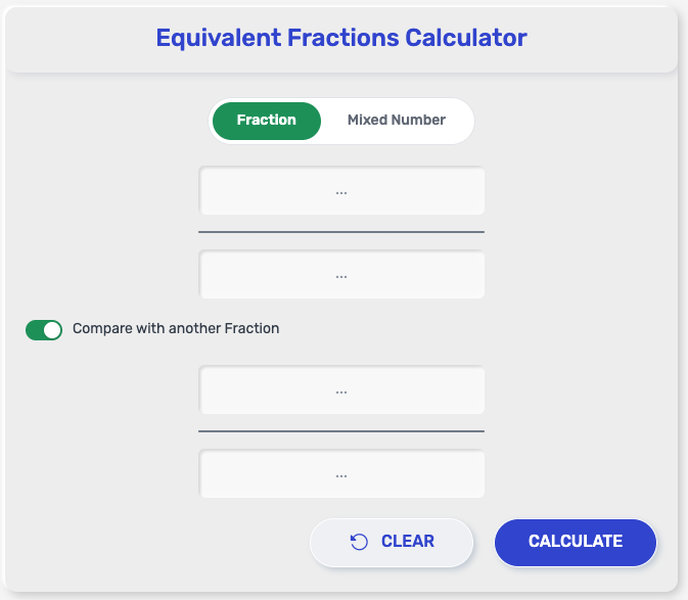
Using the equivalent fraction calculator is simple. You only need to enter the fraction you want to work with, and the tool will return equal fractions that represent the same value.
Follow these steps:
Enter the numerator in the first input box.
Enter the denominator in the second input box.
Choose the number of equivalent fractions you want to generate, if that option is available.
Click the calculate button to view the result.
Check the generated fractions and compare them with your original fraction.
The calculator works by multiplying or dividing the numerator and denominator by the same number. That is why each new result keeps the same fraction value even though the numbers look different.
You can use this tool for quick math checks, homework practice, classroom exercises, or anytime you need to confirm whether fractions are equal.
What This Equivalent Fractions Calculator Can Do
An equivalent fractions calculator gives you more than one simple result. It can turn one fraction into several equal fractions, check whether two fractions have the same value, and make fraction work faster when you need a quick answer.
With this tool, you can:
Generate multiple equivalent fractions from one original fraction
Check whether two fractions are equal
Show matching fractions with larger or smaller numerator and denominator values
Support quick fraction practice for schoolwork and self-study
Save time when reviewing math problems by hand
For example, if you enter 2⁄3, the calculator may return 4⁄6, 6⁄9, 8⁄12, and other fractions that represent the same value. Even though the numbers change, the fraction itself stays equal.
Whether you call it an equivalent fraction calculator, equivalent fraction finder, fraction equivalent calculator, or equal fractions calculator, the main purpose stays the same: showing fractions that look different but carry the same value
What the Result Means
Here is your revised version with bold and italic emphasis added naturally, and all fractions in inline code:
When the calculator shows the result, it is giving you fractions that are equal in value to the one you entered. The numbers may be different, but each fraction represents the same part of a whole.
For example, 1⁄2, 2⁄4, and 4⁄8 do not look the same at first glance, but they all mean the exact same amount. That is what makes them equivalent fractions. The calculator finds these matches by multiplying or dividing both the numerator and the denominator by the same number.
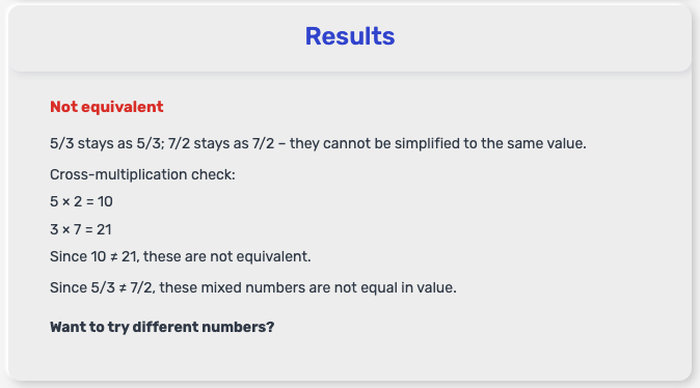
If the tool also compares two fractions, the result will tell you whether those fractions are equal or not. A match means both fractions represent the same value. A non-match means they stand for different amounts.
This result is useful when checking homework, comparing answers, rewriting fractions with a common denominator, or reviewing basic fraction rules. It gives you a fast way to confirm whether your fraction is correct without working through every step by hand.
Equivalent Fraction Formula
The equivalent fraction formula is straightforward:
a⁄b = (a × n) ⁄ (b × n)
In this formula, a is the numerator, b is the denominator, and n is any non-zero number. When you multiply both the numerator and the denominator by the same number, the value of the fraction stays the same.
For example:
1⁄2 = 2⁄4
2⁄3 = 4⁄6
3⁄5 = 6⁄10
You can also move in the opposite direction by dividing the numerator and denominator by the same number, as long as both numbers divide evenly.
For example:
6⁄8 = 3⁄4
12⁄18 = 2⁄3
This is the basic rule behind every equivalent fraction calculator. The tool applies the same operation to both parts of the fraction, then shows new fractions that represent the same value.
Equivalent Fractions with Visual Models
After you use the equivalent fractions calculator, you might see results like 1⁄2 = 2⁄4 = 4⁄8. The numbers look different, but the value stays the same. A visual model makes this much easier to see.
Quick idea: Equivalent fractions cover the same part of a whole, just divided differently.
Example with a shape:
1⁄2 → split into 2 parts, shade 1
2⁄4 → split into 4 parts, shade 2
4⁄8 → split into 8 parts, shade 4
👉 The shaded area is identical in all cases.
What actually changes?
The number of pieces increases
Each piece becomes smaller
The total shaded portion stays equal
Simple takeaway:
Multiply top and bottom → more pieces
Divide top and bottom → fewer pieces
Value → unchanged
This is exactly what the calculator is doing behind the scenes. It’s not changing the fraction’s value, just showing it in different forms.
If a result looks confusing, picture a pizza or a bar split into parts. If the filled portion is the same, the fractions are equivalent.
Quick Examples of Equivalent Fractions
A fast way to spot equivalent fractions is to look at simple number patterns. When both parts of the fraction are multiplied by the same number, the value stays the same. That is why different fractions can still represent the exact same amount.
Here are some common examples:
1/2 = 2/4 = 3/6 = 4/8
1/3 = 2/6 = 3/9 = 4/12
2/3 = 4/6 = 6/9 = 8/12
1/4 = 2/8 = 3/12 = 4/16
3/4 = 6/8 = 9/12 = 12/16
2/5 = 4/10 = 6/15 = 8/20
3/5 = 6/10 = 9/15 = 12/20
4/7 = 8/14 = 12/21 = 16/28
You can also see the same idea in reverse. A larger fraction can often be reduced to a smaller one while keeping the same value:
4/8 = 1/2
6/9 = 2/3
8/12 = 2/3
10/15 = 2/3
12/16 = 3/4
These quick examples make it easier to recognize fraction patterns in homework, worksheets, quizzes, and mental math. Once you see how the numbers change together, it becomes much easier to tell whether two fractions are equal.
Tips for Checking Whether Two Fractions Are Equal
There are a few simple ways to check whether two fractions are equal. One of the easiest methods is to reduce both fractions to their lowest terms. If they simplify to the same fraction, they are equal.
You can also look for a multiplication pattern. For example, if both the numerator and denominator of 1⁄2 are multiplied by 2, the result is 2⁄4. Since both parts changed by the same factor, the fractions are equivalent.
Another quick method is cross-multiplication. Multiply the numerator of the first fraction by the denominator of the second, then do the same with the other pair. If the two products are the same, the fractions are equal. For example, comparing 1⁄2 and 2⁄4: 1 × 4 = 4 and 2 × 2 = 4 → the results match, so the fractions are equal.
When you want a faster check, an equivalent fraction calculator gives you the answer instantly and makes comparison much easier.
Equivalent Fractions on a Number Line
After you get results from the equivalent fractions calculator, another simple way to check them is on a number line.
Same position = same value
1⁄2, 2⁄4, 3⁄6 all land at the same point
Even though the numbers look different, their position does not change
That’s why they are equivalent.
This shows that fractions are not only parts of shapes, but also precise positions on a scale. When two fractions share the same position on the number line, they represent the same value, even if the numerator and denominator are different.
If you want to see this visually step by step, this video gives a clear example of how equivalent fractions line up on a number line:
References
Khan Academy. Equivalent Fractions and Comparing Fractions https://www.khanacademy.org/math/cc-fourth-grade-math/comparing-fractions-and-equivalent-fractions
Encyclopaedia Britannica. Fraction | Equivalent, Decimal, Ratio https://www.britannica.com/science/fraction
Britannica Kids. Fractions https://kids.britannica.com/kids/article/fractions/399911
FAQ
About us
Math becomes easier when the right tools are within reach. Equivalentfractionscalculator.com was created to help students, parents, and teachers quickly understand and generate equivalent fractions in a simple, stress-free way. Whether you're checking homework, practicing fraction skills, or teaching foundational math concepts, this tool is built to make learning clearer and more accessible.
This tool was developed by the Equivalentfractionscalculator.com team, with contributions from developers, education-focused content specialists, and digital tool creators dedicated to making everyday learning tools more helpful and easy to use.
Policy
We believe learning tools should be simple, clear, and trustworthy.
No Personal Data Needed
The Equivalent Fractions Calculator does not require registration or personal information. The values you enter are used only to generate results and are not stored or shared.
Educational Use
This tool is designed to support learning, practice, and quick reference. While it aims to provide accurate equivalent fraction results, users should still review answers when using them for assignments, teaching, or study purposes.
Helpful, Not a Substitute
The calculator is meant to assist with understanding fractions, not replace classroom instruction, teacher guidance, or independent learning. It works best as a support tool alongside practice and explanation.
Updates
We may improve this tool and update this Policy from time to time. Any changes will be posted here to keep things transparent and up to date.